DELPHI
NAVEL OF THE WORLD
Delphi
stands high on the slopes of Mount Parnassus, in the heart of Phocis
at the crossroads of important routes of the ancient world. Is one
of the most famous cult sites in Greece, renowned throughout the
ancient Greek world and beyond as the sanctuary of
Apollo
and the seat of his oracle. It was at the end of the Mycenaean period
that Apollo, Olympian God and guarantor of universal harmony, is
supposed to have overcome the old underworld deities.
 |
 |
 |
| A hymn attributed
to Homer tells how, after his birth on Delos Zeus' son
came to Delphi, killed the snake Python with his bow
and arrow and in accordance with divine law, he went
into exile for eight years to atone for the killing
of the snake and on his return, he took his place, becoming
the god Python, who gave oracles through the intermediary
of the Pythia.
|
 |
 |
|
A festival consisting
dramatic and lyric contests were held in the sanctuary
theatre, and the stadium was home not only to the athletic
games, but also to musical events. Early in the 6c BC,
when the Athenians were the major power in central Greece,
they reorganized the Pythian Games at Delphi at which
sports and poetic contests were held. This was the heyday
of Delphi as a Pan-Hellenic sanctuary attracting pilgrims
from all over the Greek world, from Spain to the Black
Sea. The sanctuary was maintained by the dues paid by
those who consulted the oracle and enriched by offerings
from both Greeks and barbarians.
Delphi Tour
|
 |
|
The main entrance
to the sanctuary was at the south-east corner of the
built enclosure wall encircling it. From this point
visitors followed the Sacred Way leading to the temple
of Apollo, which was at the centre of the sanctuary.
Agora: The Romans remodeled the agora and added some
houses and baths built of brick. Down one side of the
agora ran an Ionic portico with shops for the pilgrims.
Sacred Way: No vehicles were allowed on the Sacred Way
which leads up to the temple of Apollo.

Delphi Two Day Tour
|
 |
| Votive
offerings: On the right, as one enters, stands the base
of the bull of Corcyra (Corfu), a bronze animal offered
in the 5c BC. Again on the right is the votive monument
of the Arcadians, of the Lacedaemonia, on the left the
votive monument of Marathon, which the Athenians decorated
with statues by Phidias. The Sacred Way then passes
between the foundations of two semicircular structures
erected by the Argives. The best preserved (right) was
the monument of the King of Argos, built in 369 BC,
it was decorated with 20 statues of the kings and queens
of Argos. These monuments, what little is left of them,
testify to the rivalry between the Greek cities |
 |
| Treasuries:
The first is the treasury of Sikyon, northwest of Corinth.
Beyond stands the wall of the Treasury of Siphnos, which
was built in about 525 BC by the inhabitants of the
Cycladic island out of the proceeds of its gold mines.
The Treasury of Thebes, the Treasury of the Boeotia
and a limestone of the omphalos.
Treasury of the Athenians,
which has been reconstructed by anastilosis, is a Doric
building in white Parian marble, paid for with part
of the booty captured from the Persians at Marathon.
It was decorated with sculptures illustrating the Athenians'
favorite themes: the battle between the Greeks and the
Amazons, the legends about Theses and Heracles (museum) |
 |
|
The south wall
of the terrace bears a dedication inscribed in huge
letters: "The Athenians to Apollo, after their victory
over the Persians". The base and walls of the Treasury
bear other inscriptions accompanied by crowns of laurel.
Delphi Tour
|
 |
 |
Next the Senate
of Delphi (bouleuterion), Further on are the
fallen drums of an Ionic marble column,10m high, a gift from the
Naxos to Apollo in about 570 BC, the column was surmounted by a
sphinx.
Polygonal wall:
The famous polygonal wall retaining the terrace
on which the temple of Apollo is built is 83m long, it was built
in the 6c BC of huge blocks of random - shaped limestone. The wall
is inscribed with more than 800 acts granting slaves their freedom
during the Hellenistic and Roman periods. Three columns of Pentelic
marble mark the Stoa of the Athenians, it contained the naval trophies
captured from the Persians.

| Temple approach:
The sacred Way rises steeply to the level of the temple
of Apollo. The huge stone pillar, to the right
of the temple facade, bore an equestrian statue of Prusias
(2c BC) King of Bithynia in Asia Minor. A view of Apollo’s
temple at Delphi, built in 373 B.C. with tall Doric
columns made up of thick cylindrical stones stacked
on top of one another. |
 |
 |
 |
 |
 |
Naos Apollona:
The portico, in which stood a statue of Homer, was inscribed with
the precepts of the Sages of Greece: "Know thyself", "Nothing in
excess", etc. The naos at the centre of the temple was furnished
with altars and statues: beyond was the crypt (adyton) where the
Pythia sat near the omphalos and the tomb of Dionysus.
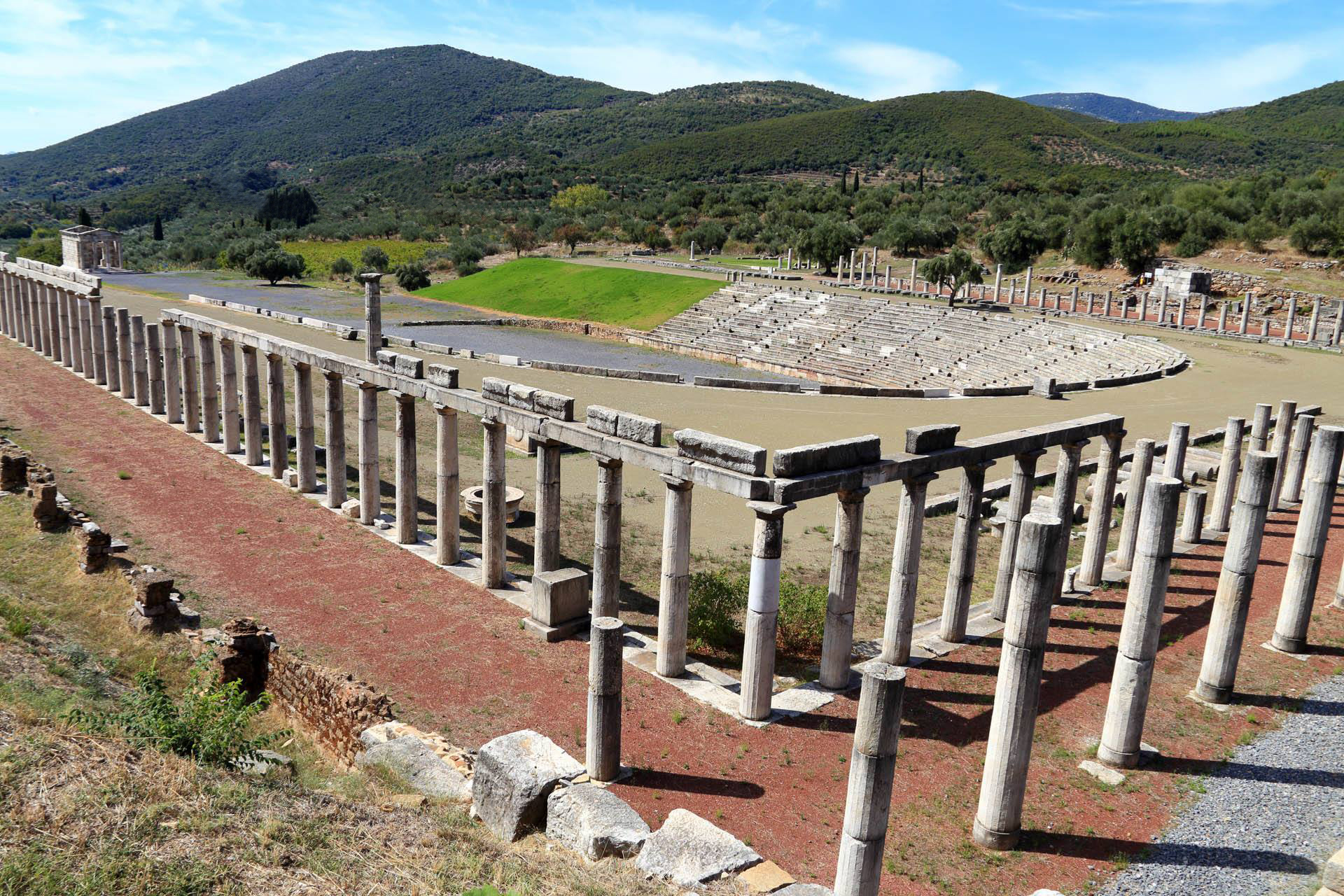
Theatre: The original theatre dates
from the 5c Bc but it was remodeled 200 years later by the Romans
who refurbished the orchestra and the stage. The 35 terraces of
seats could accommodate 5000spectators who came to watch the "mysteries"
re-enacting the struggle between Apollo and the Python as well as
to hear recitals in honor of the god. Stadium: which can hold 6500
people.

 |
To the south-east
of the sanctuary of Apollo is the sanctuary of
Athena Pronaia.
The most important buildings in it are the goddess's
two temples, dating from the 5th and 4th c. and the
Tholos,
which was built about 380BC.
A
jewel of the first half of 380 B.C. the famous Tholos
of Delphi is a work by Theodorus of Phocaea in Athena
Pronaia’s sanctuary |
 |
 |
Delphi
according to an ancient myth was at the centre of the
earth. It was said to have been discovered by Zeus,
who, wishing to find the precise center of the world,
let loose two sacred eagles from the ends of the earth.
They met above Delphi
henceforward known as the “omphalos”
or world’s navel.
 |
 |
 |
But
the legend of Apollo’s victory over
Python, serpent-son
of Ge
(the Great Mother Earth), who stood guard over a rock
chasm, the Castalia
Spring -the vapors from which inebriated men
and enabled them to make prophetic utterances –had deeper
significance than others.
Delphi Two Day Tour |
 |
 |
Originally
the priestess of the sanctuary was chosen from among
the local virgins but later she had to be a woman of
over 50 whose life was beyond reproach. Known as the
Pythia and later as the >Delphic Sibyl, she delivered
replies inspired by Apollo in answer to the questions
put the pilgrims. First she drank from Cassotis fountain
near the temple which was supposed to bestow the gift
of prophecy, then she entered the temple crypt where
she breathed the fumes of burning laurel leaves (Apollo's
tree) and barley meal. Finally she took her seat on
the famous tripod, a sort of three- footed cauldron,
near to the omphalos and Dionysus; tomb. The pilgrims
(men only) were admitted to the neighboring room where
they gave their questions to the priests who passed
them on to the Pythia.
|
 |
She
went into a trance, the sounds that she uttered, her
posture and her convulsive movements were interpreted
by the priests who delivered the oracle couched in ambiguous
phrases in hexameter verse. The replies took the form
of advise rather than predictions.
The Pythia seems to have been
well informed in politics, in turn she favored Xerxes
during the Persian invasions, then Athens, Sparta and
Thebes in the 4c BC, then Phillip of Macedon and Alexander
the Great and finally Rome.
Oracle of Delphi
|
 |
When
Julian the Apostate (361-363 AD), the last pagan emperor
of Rome, sent his quaestor, Oribasius, to consult the
Pythia oracle, its utterance was worthy to be its own
epitaph. "Go tell the king - the carven hall is felled,
Apollo has no cell, prophetic bay. Nor talking spring,
his cadenced well is stilled." It was finally
closed in 381 by the Byzantine emperor Theodosius the
Great.
The
gods still watch over Delphi Silent and invisible or
in the form of strange,
anthropomorphic clouds.
Mount. Parnassus
|
| Few statues
have ever acquired so great and well deserved a fame
as the bronze charioteer which originally belonged to
a larger group which represented a chariot with four
horses from which only small fragments survived. Its
height is 1.8 m and is made up from six separate cast
parts. Dedicated by Polyzalos, tyrant of the Sicilian
city of Gela, for his victory in the race at the Pythian
Games, probably in 474 BC. it is admired for its superb
art. |

Copyright © 1999/2010
www.toursingreece.gr
All rights reserved. Send us an e-mail.