Greek Glossary
![]() |
![]() |
![]() |
![]() |
![]() |
![]() |
![]() |
![]() |
![]() |
| ABACUS
Ancient counting frame made up of small beads threaded on wires
for mathematical calculations. It had beads which counted as
1, others had the value of 10 others, 100. By moving the beads
around complicated multiplication and division could be achieved.
|
AGORA
Open market or a
public space in ancient Greece. The word Agora drives from the
word ageiro meaning I gather. In the beginning somebody spoke
in an open space and people gathered around. Our modern term
agoraphobia, meaning fear of public places, comes from this
word. |
|
Two - handled jar with a narrow neck and sometimes a tapered base, designed for transporting or storing, olive oil or other liquid, special wine. ANDRON Small, domestic dinning room where men would entertain their male/ friends. |
ASKLEPION Religious
sanctuary and Healing center dedicated to Asklepios, the god
of medicine.
ARYBALLOS Perfume pot, usually made of pottery. These vessels were often in the shape of a fantasy creature or a real animal, such as a monkey or a hedgehog.
ATLANTES Carved male figure used as a column in classical architecture. |
CITY-STATE
A conventional city that with its surrounding territory,
is also an independent political state. Ancient Greece was
made up of a number of independent city states like Athens,
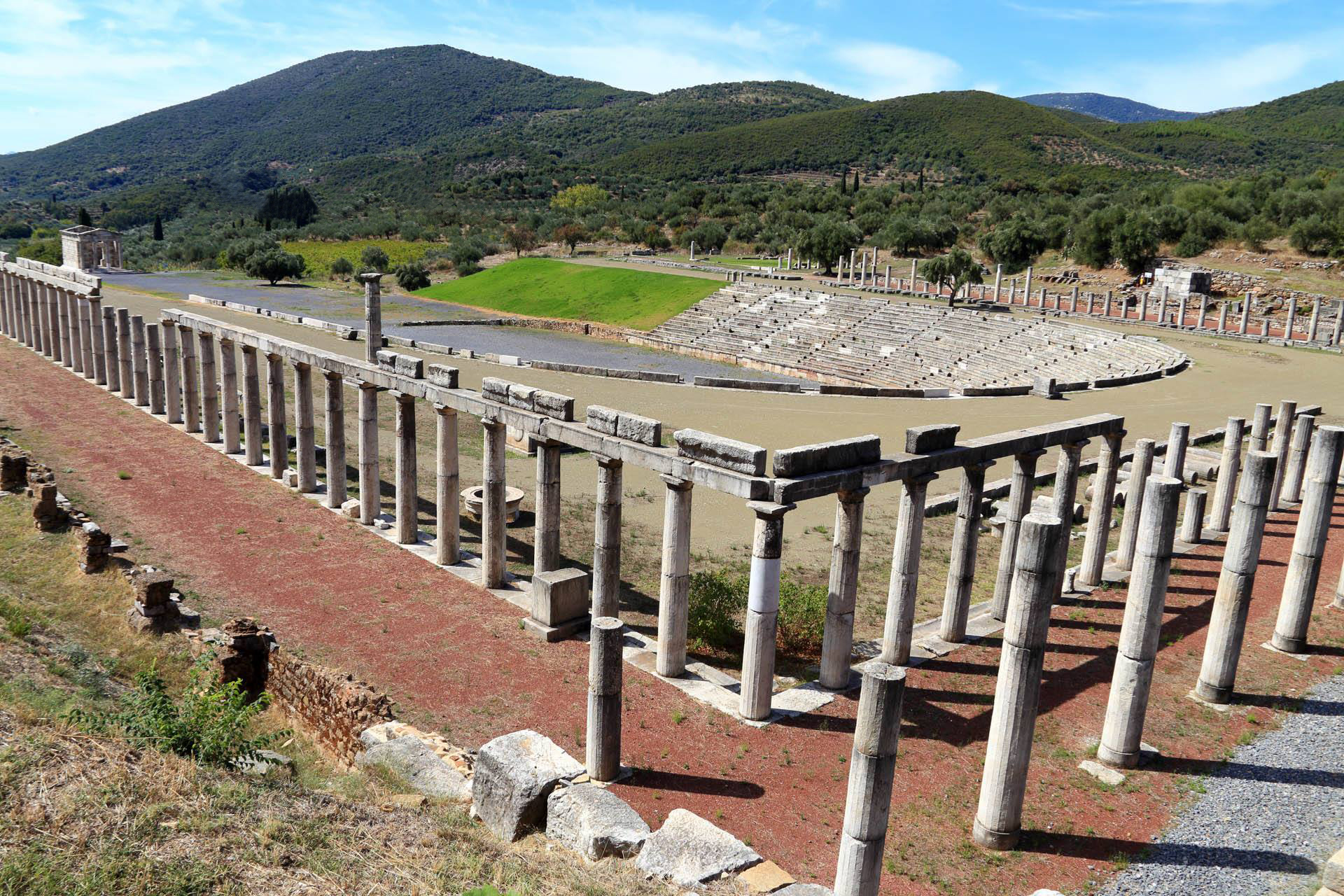
Corinth, Sparta ... and more![]() COLONNADE Line of columns supporting a row of arches, a roof, an upper story or the top part of a wall. |
|
| ASSEMBLY Gathering of people and officials that controlled public life in ancient Athens. There had to be at least 6,000 present to make an Assembly, which decided on important matters of law and state. |
![]() |
DORIC One of three principal styles (or orders) in classical architecture. Doric columns are solid with wide fluting and a plain round capital. They symbolized the male strength. |
|
COUNCIL Five
hundred strong legislative body that arranged the business of
the Assembly. It met in a round building called the tholos. DEMOS A term variously used in ancient Greece to describe the citizens, their assemblies, or the lower classes. |
![]() |
![]() |
| DEMOCRACY A system of government in which the people being governed have a voice, usually through elected representatives. It was invented in Athens. Meetings took place on a hill called the Pnyx near the Acropolis. Ordinary citizens, rich or poor, could make a speech and vote at the Assembly |
![]() |
IONIC One of three principal styles (or orders) in classical architecture. Ionic columns are slender with narrow fluting and a scrolled capital. They symbolize the female shape, as opposed the Doric which symbolizes the male shape |
EMBLEM
The Athens 2004 Olympic Games' emblem is an olive wreath - the
"kotinos" with which the Olympic winner was crowned in classical
times. It is a symbol linked with the Olympic ideals, peace
and the city of Athens, whose sacred tree was the olive tree.
Its circular shape projects universal meanings of the unity
of the world, the circle of life and the link between time past
and present. |
A sacred truce was kept during the period of the games and attempts were made to settle wars and conflicts between the (poleis -cities) based on reasoning inspired by Zeus. |
|
GYMNASIUM A derivative of the word gymnos - nude. It was a place comprising sports grounds and buildings (including baths) where athletes exercised naked.
PALAISTRA Purpose designed building, smaller than a gymnasium, with dressing rooms and a sand covered courtyard where Greek boys were taught athletics and wrestling. |
HIMATION Outer cloak worn by ancient Greeks. This garment was traditionally pulled under the right arm and draped over the left shoulder. CHITON Basic item of clothing for both man and women in ancient Greece. Chitons were made from two rectangles of fabric fastened at the shoulders and down the sides and tied at the waist. |
|
HEROON A temple or funerary monument dedicated to a hero, the offspring of a god and a human.
ORACLE
Sacred place where ancient Greeks could ask their gods, through
a priestess, to give them advise or to foretell the future.
The most famous oracle was that of Apollo at Delphi. |
![]()
ORCHESTRA
Flat circular area where the actors and chorus performed in
a Greek theatre. The first stone theatre ever built, and the
birthplace of Greek tragedy, was the theatre of Dionysus, which
was cut into the southern cliff face of the Acropolis.
|
Ostracism was first introduced by Cleisthenes in the 5th century, as a guard against tyranny. It was intended to serve as a safeguard against one individual gaining a disproportionate amount of power and influence in Athens; the punishment for one who was ostracized was 10 years of exile from Attica. The name ostracism is derived from the broken sherds of pottery that were used to cast votes. These sherds, called ostraka (or ostrakon, singular), were inscribed with the name of who one wished to exile and then deposited in urns to be counted. Ostraka have been found of vastly different materials--there are examples of sherds from figured, black-glazed, or plain pottery, as well as fragments from rooftiles and well heads. Approximately 11,000 ostraka have been found in the ancient Agora as well as the Athenian Karameikos, or potters quarter.
It is important to note that Ostracism was not designed
as a criminal punishment; the individuals who were ostracized, although
forced to live away from Attica for a decade, were free to return after
that period without any stigma. In addition, the wealth, property, and status
of the exiled were protected; when an ostracized individual returned to
Attica, they would be restored to their previous position in society.
![]()
|
SYMPOSIA All male drinking parties. Small, private symposia were held in private homes, when numbers increased, public buildings would be used. PEDAGOGIES Domestic slaves with particular responsibility for accompanying Greek boys to school. |
STRATEGOI One of ten elected military leaders responsible for making decisions about the defense of ancient Athens or concerning its involvement in a war. TYRANT Absolute ruler of a Greek city - state who had usually seized power by force. Ancient Greece was made up of a number of independent city-states. There were very few rich people and a great number of poor. In early times, the rich landowners and leaders called tyrants controlled the poor. In Athens and some other city-states the tyrants were driven out by the people, who acquired power and freedom. This new form of government was called democracy. |
TRIREME
Fast warship powered by up to 170 oarsmen positioned over three
levels on either side of the hull. The trireme was the most
widely used warship in ancient Greece. Alight hull ballasted
with blocks of stone in the hold, had three decks which housed
the banks of oarsmen, while the bridge accommodated the troops
to be landed or, more often, ready to board enemy ships after
they have been rammed. At the prow was a pointed ram strengthened
with metal, which could sink enemy ships. |
|
Copyright © 2000/2011 www.toursingreece.gr All rights reserved. Send us an e-mail.