OLYMPIA
ANCIENT CAPITAL OF PEACE AND
SPORT...
General Background
In
the west of the Peloponnese, 16 km inland from the Ionian Sea, the main
road out of Pyrgos leads into legendary Olympia’s. In a peaceful and luxuriant
valley at the confluence of the rivers
Alpheus and Cladeus,
the vast archaeological site of Olympia stretches over the lower slopes
of a hill covered with pines and olive trees that fill the air with fragrance
on hot summer days.
Geography - Demography
The modern village of Ancient Olympia lies on a hill, near the remains of
the magnificent and glorious structures of Olympia. Population: 1,812 inhabitants.
Here is also the Museum of the Modern Olympic Games, with many choice items
from the Modern Olympic Games on display (torches, stamps, and so on).
History and Mythology
The first Olympic Games were held in 776 BC, after
the ‘descent of the Dorians’ to southern Greece and after the worship of
Zeus had started to spread. It was a king of Elis, Iphitos, who established
that the Games were to be held every four years. Athletes came to Olympia
from towns on the Greek mainland - and later on from Ionia and Sicily too
– to compete at Olympia for four days. At first there were only half a dozen
sports, but in the fifth century BC they increased to thirteen. The prize
was a kotinos, or wreath of intertwined olive branches, and it was a prize
that any athlete or city longed to win. The heyday of the Olympic Games
was from the sixth to the fourth century BC. The institution of the ‘sacred
truce’ meant that city-states temporarily ceased hostilities, which helped
them settle their disputes and realize the unity of the Hellenic nation.
It was a major religious, cultural and sporting centre, a pole of attraction
for Hellenism,
and the bond that linked motherland Greece with the colonies of the Mediterranean
and the Black Sea. The celebrations at Games-time lent the city religious
splendor and influence until the 4th century BC. The sanctuary of Olympia
was pillaged by the Romans in 74 BC in the course of their conquest of Greece.
The Games lost their glory and the main purpose under Hadrian. Thereafter,
Olympia played neither a religious nor a political role and the crowds filled
the stadium from curiosity, not from faith or respect. The Games went on
until 393 AD, a year before Theodosios II ‘the Great’ prohibited “pagan”
festivals. In 426 AD, Theodosios ordered the destruction of all pagan temples.
In the following years, an earthquake, fire and pillage completed his work.
The first excavations - by the French scientific mission of Blouet and Dubois
in May 1829 revealed the exact position of the temple of Zeus. In 1875,
the Greek Parliament ratified an agreement with the German Archaeological
Institute, authorizing them to undertake the excavations, which are still
under way.
Olympia Tour
Olympic Games
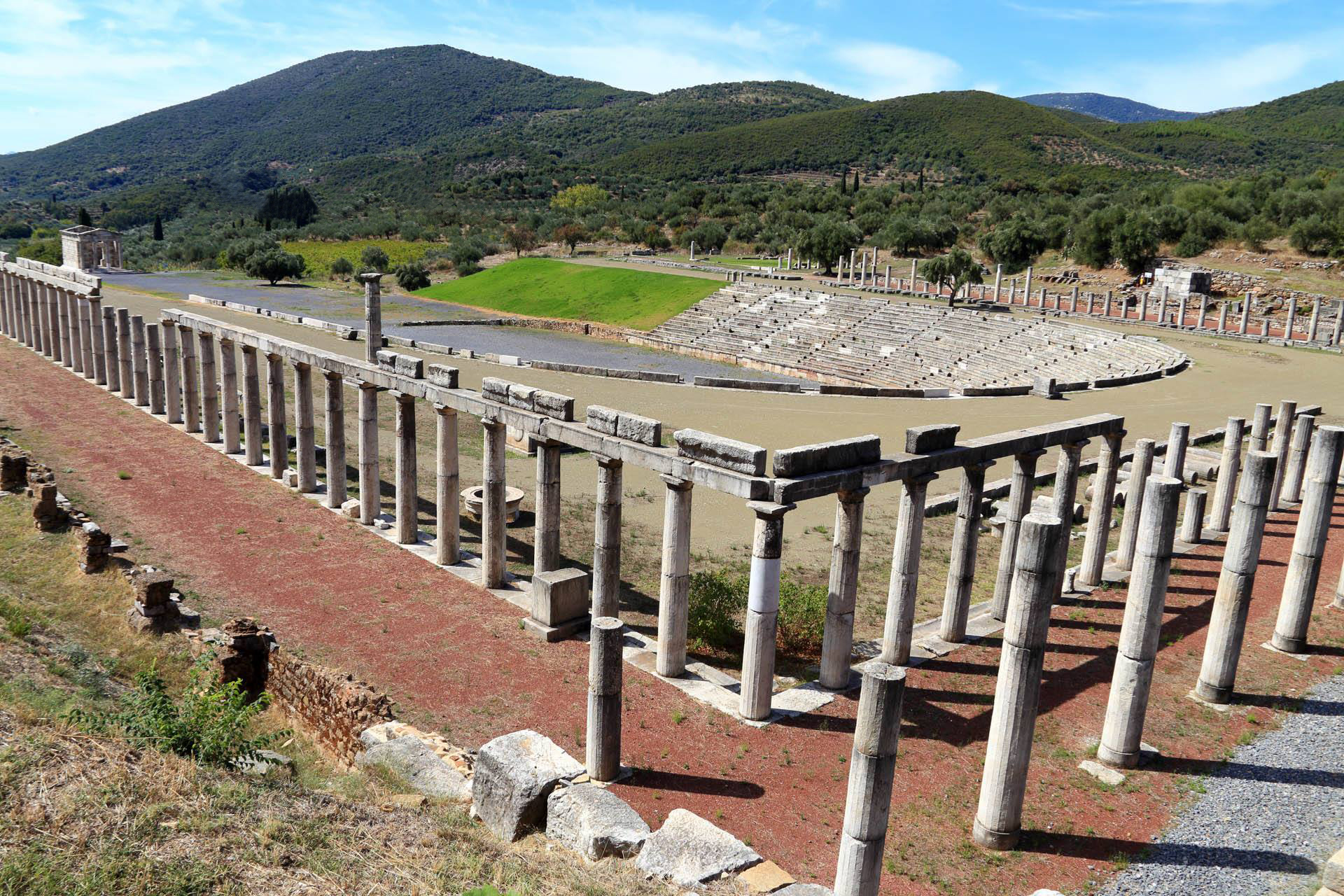
Gymnasium and Palaestra (Wrestling
House). The gymnasium in ancient Greece functioned
as a training facility for competitors in public games. It was also a place
for socializing and engaging in intellectual pursuits. The name comes from
the Greek term gymnos meaning naked. Athletes competed in the nude, a practice
said to encourage aesthetic appreciation of the male body and a tribute
to the Gods. Gymnasia were typically large structures containing spaces
for each type of exercise as well as a stadium, palaistra, baths, outer
porticos for practice in bad weather, and covered porticos where philosophers
and other "men of letters" gave public lectures and held disputations.

 |
The palaestra was the
ancient Greek wrestling
school. The events that did not require a lot of space, such
as
boxing
and
wrestling,
were practiced there. The palaestra functioned both independently
and as a part of public
gymnasia.
A palaestra could exist without a gymnasium, but no gymnasium
could exist without a palaestra. The
palaestra at Olympia
is centered around a large courtyard covered with sand for use
as a boxing or
wrestling surface. Along
all four sides of the palaestra are rooms that opened onto the
porticoes. It is not possible to say for what most of the other
rooms lining the porticoes were used. Since Olympia had no resident
population, the palaestra and gymnasium would not have included
spaces for lectures or intellectual discourse and would have
been used primarily by competitors in the sanctuary games.
|
|
The workshop of Fidias
'Phidias' (c.480 BC - c.430 BC), son of Charmides,
(not to be mistaken for the Charmides who participated in the
tyranny at Athens) , was an ancient Greek sculptor, painter
and architect, universally regarded as the greatest of all Classical
sculptors. Phidias designed the statues of the goddess Athena
on the Athenian Acropolis (Athena Parthenos inside the Parthenon
and the Athena Promachos) and the colossal seated Statue of
Zeus at Olympia in the 5th century BC. The workshop of
Pheidias was turned into a Basilica and the site was inhabited
by a Christian community until the late 6th century. After this
point the site was buried under the alluvial deposits of two
rivers until its discovery by archaeologists in the 19th century

|
 |
|
Leonidaion:The Leonidaion
was the lodging place for athletes taking part in the
Olympic
Games at
Olympia.
It was located at the southwest edge of the sanctuary and was
the largest building on the site. It was constructed around
330 BCE and was funded and designed by Leonidas of Naxos. The
building consisted of four
Ionian
colonnades with 138 decorated columns, forming a square of approximately
80 metres. In its interior there was a central
Doric
peristyle with 44 columns.
It consists of four ranges
of rooms set around an atrium with a circular pool in the centre
added by the Romans.
Olympia Tour
|
 |
|
The ancient sanctuary
of Zeus was the place
where all ancient Greeks abandoned the politic rivalries of
their city-states and were united in worship of the gods as
they celebrated their common ethnic and cultural roots. The
Olympic games probably began as a local funerary celebration
in honour of Pelops
. The first historical reference to the Games in
776 BC. when a treaty between kings
Iphitos of Elis and
Lykourgos of Sparta provided for an Olympic truce (ekecheiria)
during the summer Games. From 776 BC. onwards lists were kept
of the winners in the foot - race round the Stadion, giving
rise to the Greek method of chronological reckoning by olympiads.
Every four years Greeks
from all over the Greek world gathered in this sanctuary to
participate in the Olympiada.
A sacred truce was kept during the period of the games and attempts
were made to settle wars
|
 |
 |
Naos Dios: A ramp leads
up to the terrace supporting the great temple of Zeus which
was built in the 5c BC of local shell- limestone, covered with
a layer of stucco. The entablature and study columns have collapsed
and their drums and capitals lie in pieces at the foot of the
high steps of the stylobate The chaotic heap of stones, the
enormous drums and capitals of the columns thrown down by an
earthquake in the 6c AD create a dramatic effect. The pediments
were decorated with sculptures (museum) illustrating the chariot
race between Oinomaos and Pelops as well as the battle of the
Lapinths and Centaurs, the friezes at the entrance to the pronaos
and the opisthodromos were composed of 12 sculpted metopes (museum)
of the Twelve Labors of Heracles.
The naos, which consisted of a nave and
two aisles, contained the famous statue of Olympian Zeus, one
of the "Seven Wonders of the World".
|
 |
 |
It was a
huge chryselephantine figure (about 13.50m high) representing
the king of the gods in majesty, seated on a throne of ebony
and ivory holding a scepter surmounted by a n eagle in his left
hand and a Victory, also chryselephantine, in his right., his
head was crowned with an olive wreath.
 |
 |
 |
 |
 |
 |
Philippeion:
this circular votive monument was built in the 4c BC in the
Ionic order. It was begun by Phillip of Macedon and completed
by Alexander the Great. The Philippeion
in the Altis of Olympia was an Ionic circular memorial of ivory
and gold, which contained statues of Philip's family,
Alexander
the Great, Olympias, Amyntas III and Eurydice II.
It was made by athenian sculptor Leochares in celebration of
Philip's victory at Battle of Chaeronea (338 BC).
|
 |
 |
 |
 |
 |
 |
 |
 |
 |
 |
 |
 |
 |
 |
 |
 |
 |
Naos Heras (Heraion)
The Temple of Hera, or the Heraion,
at Olympia, Greece, is an important monument of the ruins of
Doric
architecture.
In modern times, the temple is the location where the torch
of the Olympic flame is lit, by focusing the rays of the sun.
The temple was dedicated to Hera, the wife of Zeus and one of
the most important female deities in Greek religion.
|
 |
 |
A few columns have been
re-erected among the remains of the imposing foundations of
the temple of Hera. Within stood an effigy of Hera, of which
the colossal head has been found, and one of Zeus, as well as
many others statues which included the famous Hermes by Praxiteles.
The opening ceremony of the Olympic Games
is marked with the arrival of the
Olympic flame which
is taken on every occasion from Era's alter,
|
 |
The Olympic Torch today
is ignited several months before the opening celebration of
the Olympic Games at the
site of the ancient Olympics
in Olympia, Greece. Eleven
women, representing the roles of priestesses, perform a ceremony
in which the torch is kindled by the light of the Sun, its rays
concentrated by a parabolic mirror.
The Olympic Torch Relay ends on the day of the opening ceremony
in the central stadium of the Games. The final carrier is often
kept secret until the last moment, and is usually a sports celebrity
of the host country. The final bearer of the torch runs towards
the cauldron, usually placed at the top of a grand staircase,
and then uses the torch to start the flame in the stadium. It
is generally considered a great honor to be asked to light the
Olympic Flame.

|
 |
Stadium:
The
first stadium was constructed around 560 BCE, it consisted of
just a simple track. The stadium was remodelled around 500 BCE
with sloping sides for spectators and shifted slightly to the
east. In the 3c BC
a passage was built beneath the terraces to link the sanctuary
to the stadium. The Crypt a vaulted passageway linking the Stadium
with the Altis, was built at the end of the 3rd c. BC.
The starting and finishing lines are still visible, the distance
between them was a stadium (about 194yd). The finishing line
(nearest the passage) was marked by a cippus, a small low column
acting as a goal or a marker round which the runners ran if
the race consisted of more than one length of the stadium, the
starting line was marked by several cippi.
 |
|
The spectators, men only,
were ranged on removable wooden stands mounted on the bank surrounding
the stadium. It was enlarged several times until it could accommodate
20000 people. In the middle of the south side there was a paved
marble enclosure where the judges sat.
The
word originates from the Greek word "stadion" (στάδιον), literally
a "Stand", (a place where people stand.) The oldest known stadium
is the one in Olympia,
in western Peloponnese,
Greece, where the
Olympic Games of antiquity
were held since 776 BC.
Initially 'the Games' consisted of a single event, a
sprint along the length of the stadium. Therefore the length
of the Olympia stadium was more or less standardized as a measure
of distance (approximately 190 meters or 210 yd).
|
 |
Olympia Tour
Classical Tour
Peloponnesian Tour

Copyright
© 1999/2010 www.toursingreece.gr
All rights reserved. Send us an e-mail.